Файл:Academ Periodic tiling by squares of two different sizes.svg

Краткое описание
| Описание |
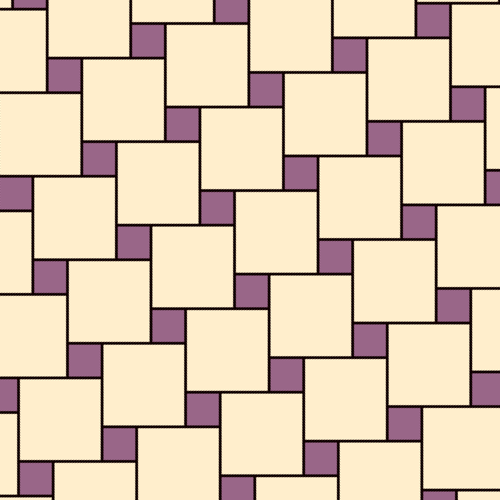
English: In order to prove the Pythagorean theorem, such a tessellation and its pattern grid can be associated to a set of puzzle pieces, as shown below.
This classical tiling is created from a given right triangle. An Euclidean plane is entirely covered with an infinity of squares, the sizes of which are the leg lengths of the given triangle: a and b. On this drawing, every square element of the tiling has a slope equal to the ratio of sizes: a / b = tan 22.5°, and a square pattern is indefinitely repeated horizontally and vertically, if we forget patternTransform="rotate(67.5)": see <pattern id="pg" in the source code. See another page for more informations. |
| Дата | |
| Источник | Собственная работа |
| Автор | Baelde |
| Другие версии |
    On three previous images, the hypotenuses of copies of the given triangle are in dashed red. On left, a periodic square in dashed red takes another position relative to the tiling: its center is the one of a small tile. And one of the puzzle pieces is square, its size is the one of a small tile. The four other puzzle pieces can form together another tile, and they are congruent, because of a rotation of a quarter turn around the center of a large tile that transforms at the same time the tiling and the grid in dashed red into themselves. Therefore the area of a large tile equals four times the area of one of these four puzzle pieces. In case where the initial triangle is isosceles, the midpoint of any segment in dashed red is a common vertex of four tiles with equal sizes: a = b, and each puzzle piece which is a quarter of a tile is an isosceles triangle. Whatever the shape of the initial triangle, the two assemblages of the five puzzle pieces have equal areas: Periodic tilings by squares, images coded with a pattern element in SVG |
| SVG‑разработка |




|
Это изображение полагается или частично полагается на передачу информации через цвета. Используемые в этом файле цвета были выбраны таким образом, чтобы оставаться визуально различимыми даже для людей с цветовой слепотой. При изменении этого файла, пожалуйста, убедитесь, что в результате он остается доступным для людей с цветовой слепотой.
|
Лицензирование


- Вы можете свободно:
- делиться произведением – копировать, распространять и передавать данное произведение
- создавать производные – переделывать данное произведение
- При соблюдении следующих условий:
- атрибуция – Вы должны указать авторство, предоставить ссылку на лицензию и указать, внёс ли автор какие-либо изменения. Это можно сделать любым разумным способом, но не создавая впечатление, что лицензиат поддерживает вас или использование вами данного произведения.
- распространение на тех же условиях – Если вы изменяете, преобразуете или создаёте иное произведение на основе данного, то обязаны использовать лицензию исходного произведения или лицензию, совместимую с исходной.

|
Разрешается копировать, распространять и/или изменять этот документ в соответствии с условиями GNU Free Documentation License версии 1.2 или более поздней, опубликованной Фондом свободного программного обеспечения, без неизменяемых разделов, без текстов, помещаемых на первой и последней обложке. Копия лицензии включена в раздел, озаглавленный GNU Free Documentation License. |
История файла
Нажмите на дату/время, чтобы увидеть версию файла от того времени.
| Дата/время | Миниатюра | Размеры | Участник | Примечание | |
|---|---|---|---|---|---|
| текущий | 10:00, 26 сентября 2012 | | 750 × 750 (716 байт) | wikimediacommons>Baelde | {{Information |Description ={{en|1=The image evokes a covering of the entire Euclidean plane with an infinity of squares of two different sizes.}} |Source ={{own}} |Author =Baelde |Date =2012-09-26 |Per... |
Использование файла
Следующая страница использует этот файл:
