Файл:G29-38 Spectra.jpg
Перейти к навигации
Перейти к поиску

Размер этого предпросмотра: 750 × 600 пкс. Другие разрешения: 300 × 240 пкс | 600 × 480 пкс | 960 × 768 пкс | 1280 × 1024 пкс | 2560 × 2048 пкс | 3000 × 2400 пкс.


Исходный файл (3000 × 2400 пкс, размер файла: 445 КБ, MIME-тип: image/jpeg)

Краткое описание
| Описание |
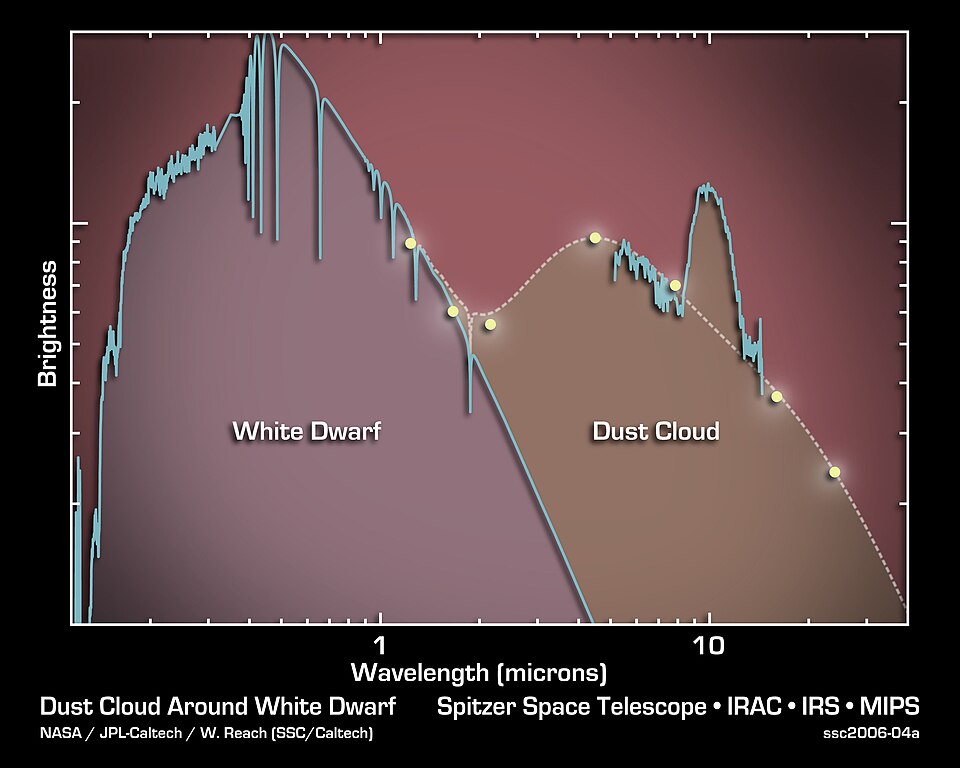
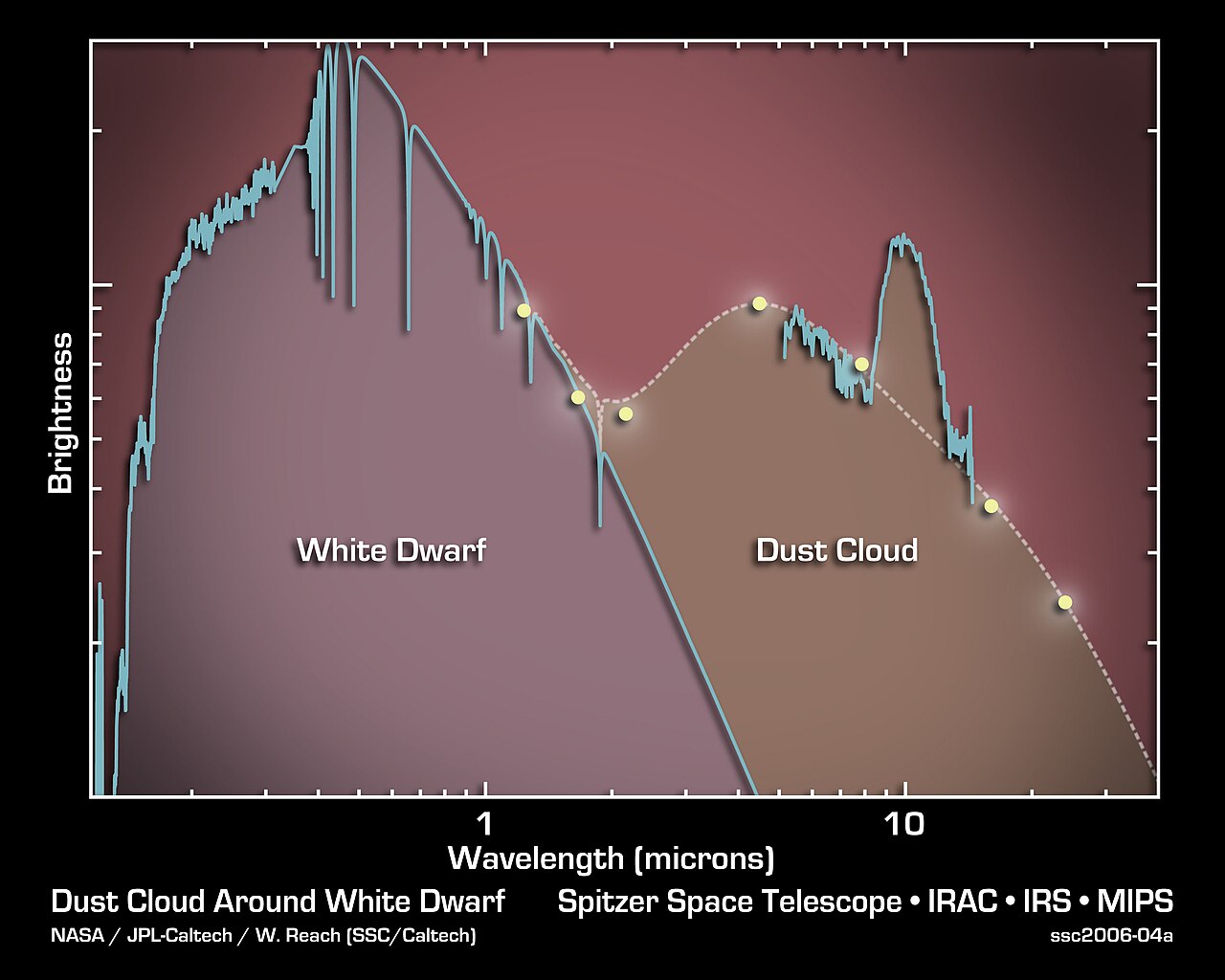
English: The graph of data, or spectrum, from NASA's Spitzer Space Telescope indicates that a dead star, or white dwarf, called G29-38, is shrouded by a cloud of dust. The data also demonstrate that this dust contains some of the same types of minerals found in comet Hale-Bopp.
The findings tell a possible tale of solar system survival. Though the dust seen by Spitzer is likely from a comet that recently perished, its presence suggests that an icy distant ring of comets may still orbit the dead star. These data were collected by Spitzer's infrared spectrometer, an instrument that cracks light open like a geode, revealing its coveted components. In this spectrum, light from the white dwarf is on the left, at ultraviolet and visible wavelengths. The spectrum on the right, at infrared wavelengths longer than about 2 microns, shows much more light than can be explained by a white dwarf alone. The bump seen around a wavelength of 10 microns offers a clue to the source of this excess infrared light. It signifies the presence of silicate minerals, which are found in our own solar system on Earth, in sandy beaches, and in comets and asteroids. These silicate grains appear to be very small like those in comets, so astronomers favor the theory that a comet recently broke apart around the dead star. |
| Дата | (released) |
| Источник | http://photojournal.jpl.nasa.gov/catalog/PIA03652; see also http://www.spitzer.caltech.edu/images/1558-ssc2006-04a-Evidence-for-Comets-Found-in-Dead-Star |
| Автор | NASA/JPL-Caltech/M. Kuchner (GSFC) |

|
Это изображение или видеозапись внесены в каталог Лаборатории реактивного движения НАСА под идентификатором (Photo ID): PIA03652 и под альтернативным идентификатором: ssc2006-04a. Эта пометка не указывает на правовой статус произведения. По-прежнему необходим нормальный шаблон лицензии. См. подробнее правила лицензирования Викисклада. Другие языки:
|
Лицензирование

|
Этот файл находится в общественном достоянии (англ. public domain), так как он был создан NASA (Национальным управлением по аэронавтике и исследованию космического пространства). Политика авторского права NASA гласит, что «Материал NASA не защищается авторским правом, если не указано иное». (См. Template:PD-USGov, страницу политики авторского права NASA или политику использования изображений JPL.) |  |
 |
Предупреждения:
|
История файла
Нажмите на дату/время, чтобы увидеть версию файла от того времени.
| Дата/время | Миниатюра | Размеры | Участник | Примечание | |
|---|---|---|---|---|---|
| текущий | 18:14, 29 августа 2007 | | 3000 × 2400 (445 КБ) | wikimediacommons>WilyD | The graph of data, or spectrum, from NASA's Spitzer Space Telescope indicates that a dead star, or white dwarf, called G29-38, is shrouded by a cloud of dust. The data also demonstrate that this dust contains some of the same types of minerals found in co |
Использование файла
Следующая страница использует этот файл:
