Файл:NonConvex.gif
Перейти к навигации
Перейти к поиску
Нет версии с бо́льшим разрешением.
NonConvex.gif (360 × 392 пкс, размер файла: 782 КБ, MIME-тип: image/gif, закольцованный, 84 фрейма, 4,2 с)
Краткое описание
| Описание |
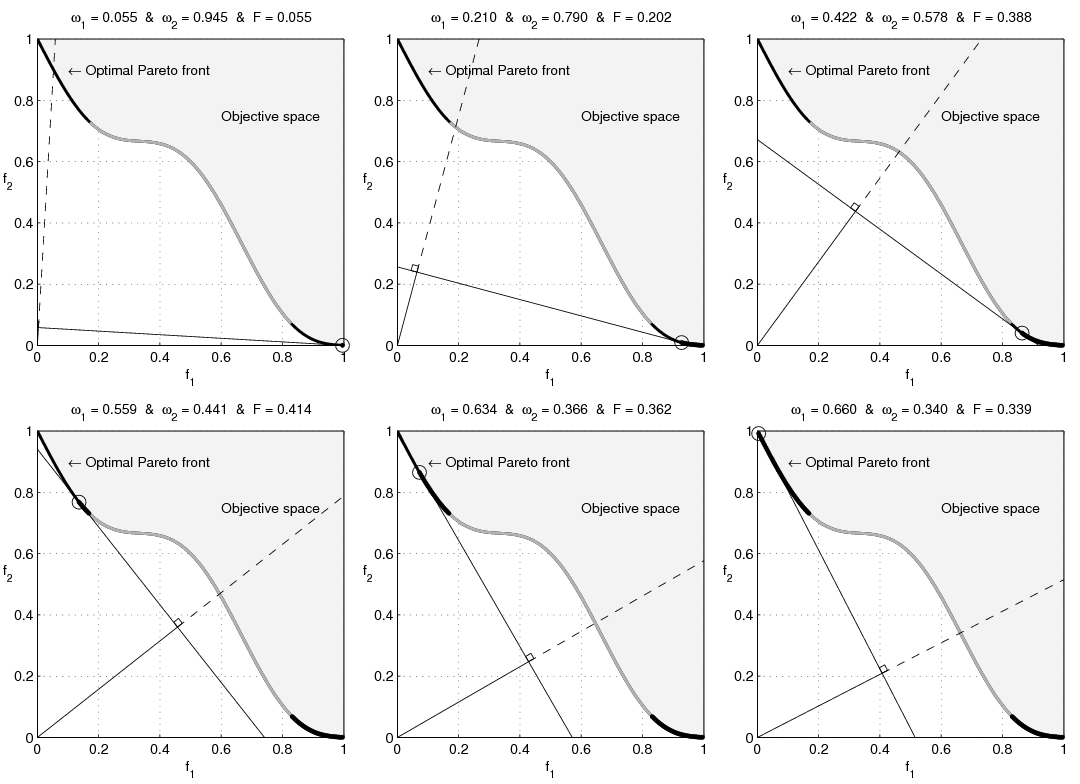
English: Weighted-sum approach is an easy method used to solve multi-objective optimization problem. It consists in aggregating the different optimization functions in a single function. However, this method only allows to find the supported solutions of the problem (i.e. points on the convex hull of the objective set). This animation shows that when the outcome set is not convex, not all efficient solutions can be found
Français : La méthode des sommes pondérées est une méthode simple pour résoudre des problèmes d'optimisation multi-objectif. Elle consiste à aggréger l'ensemble des fonctions dans une seule fonction avec différents poids. Toutefois, cette méthode permet uniquement de trouver les solutions supportées (càd les points non-dominés appartenant à l'enveloppe convexe de l'espace d'arrivée). Cette animation montre qu'il n'est pas possible d'identifier toutes les solutions efficaces lorsque l'espace d'arrivée est n'est pas convexe. |
| Дата | |
| Источник | Собственная работа |
| Автор | Guillaume Jacquenot |
| GIF‑разработка |  Это diagram было создано с помощью MATLAB Это diagram было создано с помощью MATLAB |
Source code (MATLAB)
function MO_Animate(varargin)
% This function generates objective space images showing why
% sum-weighted optimizer can not find all non-dominated
% solutions for non convex objective spaces in multi-ojective
% optimization
%
% Guillaume JACQUENOT

if nargin == 0
    % Simu = 'Convex';
    Simu = 'NonConvex';
    save_pictures = true;
    interpreter = 'none';
end

switch Simu
    case 'NonConvex'
        a = 0.1;
        b = 3;
        stepX = 1/200;
        stepY = 1/200;
    case 'Convex'
        a = 0.2;
        b = 1;
        stepX = 1/200;
        stepY = 1/200;
end

[X,Y] = meshgrid( 0:stepX:1,-2:stepY:2);

F1 = X;
F2 = 1+Y.^2-X-a*sin(b*pi*X);

figure;
grid on;
hold on;
box on;
axis square;
set(gca,'xtick',0:0.2:1);
set(gca,'ytick',0:0.2:1);

Ttr = get(gca,'XTickLabel');
Ttr(1,:)='0.0';
Ttr(end,:)='1.0';
set(gca,'XTickLabel',[repmat(' ',size(Ttr,1),1) Ttr]);

Ttr = get(gca,'YTickLabel');
Ttr(1,:)='0.0';
Ttr(end,:)='1.0';
set(gca,'YTickLabel',[repmat(' ',size(Ttr,1),1) Ttr]);

if strcmp(interpreter,'none')
    xlabel('f1','Interpreter','none');
    ylabel('f2','Interpreter','none','rotation',0);
else
    xlabel('f_1','Interpreter','Tex');
    ylabel('f_2','Interpreter','Tex','rotation',0);
end

set(gcf,'Units','centimeters')
set(gcf,'OuterPosition',[3 3 3+6 3+6])
set(gcf,'PaperPositionMode','auto')

[minF2,minF2_index] = min(F2);
minF2_index = minF2_index + (0:numel(minF2_index)-1)*size(X,1);

O1 = F1(minF2_index)';
O2 = minF2';

[pF,Pareto]=prtp([O1,O2]);

fill([O1( Pareto);1],[O2( Pareto);1],repmat(0.95,1,3));

text(0.45,0.75,'Objective space');
text(0.1,0.9,'\leftarrow Optimal Pareto front','Interpreter','TeX');

plot(O1( Pareto),O2( Pareto),'k-','LineWidth',2);
plot(O1(~Pareto),O2(~Pareto),'.','color',[1 1 1]*0.8);
V1 = O1( Pareto); V1 = V1(end:-1:1);
V2 = O2( Pareto); V2 = V2(end:-1:1);

O1P = O1( Pareto);
O2P = O2( Pareto);

O1PC = [O1P;max(O1P)];
O2PC = [O2P;max(O2P)];
ConvH = convhull(O1PC,O2PC);
ConvH(ConvH==numel(O2PC))=[];
c = setdiff(1:numel(O1P), ConvH);

% Non convex
O1PNC = O1PC(c);

[temp, I1] = min(O1PNC);
[temp, I2] = max(O1PNC);

if ~isempty(I1) && ~isempty(I2)
    plot(O1PC(c),O2PC(c),'-','color',[1 1 1]*0.7,'LineWidth',2);
end

p1 = (V2(1)-V2(2))/(V1(1)-V1(2));
hp = plot([0 1],[p1*(-V1(1))+V2(1) p1*(1-V1(1))+V2(1)]);
delete(hp);

Histo_X = [];
Histo_Y = [];
coeff = 0.02;
Sq1 = coeff *[0 1 1 0 0;0 0 1 1 0];
compt = 1;
for i = 2:1:length(V1)-1
    if ismember(i,ConvH)
        p1 = (V2(i+1)-V2(i-1))/(V1(i+1)-V1(i-1));
        x_inter = 1/(1+p1^2)*(p1^2*V1(i)-p1*V2(i));
        hp1 = plot([0 1],[p1*(-V1(i))+V2(i) p1*(1-V1(i))+V2(i)],'k');
        % hp2 = plot([x_inter],[-x_inter/p1],'k','Marker','.','MarkerSize',8)
        hp3 = plot([0 x_inter],[0 -x_inter/p1],'k-');
        hp4 = plot([x_inter 1],[-x_inter/p1 -1/p1],'k--');
        hp5 = plot(V1(i),V2(i),'ko','MarkerSize',10);

        % Plot the square for perpendicular lines
        alpha = atan(-1/p1);
        Mrot = [cos(alpha) -sin(alpha);sin(alpha) cos(alpha)];
        Sq_plot = repmat([x_inter;-x_inter/p1],1,5) + Mrot * Sq1;
        hp7 = plot(Sq_plot(1,:),Sq_plot(2,:),'k-');

        Histo_X = [Histo_X V1(i)];
        Histo_Y = [Histo_Y V2(i)];
        hp6 = plot(Histo_X,Histo_Y,'k.','MarkerSize',10);

        w1 = p1/(p1-1);
        w2 = 1-w1;
        Fweight_sum = V1(i)*w1+w2*V2(i);
        Fweight_sum = floor(1e3*Fweight_sum )/1e3;

        w1 = floor(1000*w1)/1e3;
        str1 = sprintf('%.3f',w1);
        str2 = sprintf('%.3f',1-w1);
        str3 = sprintf('%.3f',Fweight_sum);
        if (strcmp(str1,'0.500')||strcmp(str1,'0,500')) && strcmp(Simu,'NonConvex')
            disp('Two solutions');
        end
        title(['\omega_1 = ' str1 '  &  \omega_2 = ' str2 '  &  F = ' str3],'Interpreter','TeX');
        axis([0 1 0 1]);
        file = ['Frame' num2str(1000+compt)];
        if save_pictures
            saveas(gcf, file, 'epsc');
        end
        compt = compt +1;
        pause(0.001);
        delete(hp1);
        delete(hp3);
        delete(hp4);
        delete(hp5);
        delete(hp6);
        delete(hp7);
    end
end
disp(['Number of frames :' num2str(length(V1))]);
return;

function [A varargout]=prtp(B)
% Let Fi(X), i=1...n, are objective functions
% for minimization.
% A point X* is said to be Pareto optimal one
% if there is no X such that Fi(X)<=Fi(X*) for
% all i=1...n, with at least one strict inequality.
% A=prtp(B),
% B - m x n input matrix: B=
% [F1(X1) F2(X1) ... Fn(X1);
%  F1(X2) F2(X2) ... Fn(X2);
%  .......................
%  F1(Xm) F2(Xm) ... Fn(Xm)]
% A - an output matrix with rows which are Pareto
% points (rows) of input matrix B.
% [A,b]=prtp(B). b is a vector which contains serial
% numbers of matrix B Pareto points (rows).
% Example.
% B=[0 1 2; 1 2 3; 3 2 1; 4 0 2; 2 2 1;...
%    1 1 2; 2 1 1; 0 2 2];
% [A b]=prtp(B)
% A =
%      0     1     2
%      4     0     2
%      2     2     1
% b =
%      1     4     7
A=[]; varargout{1}=[];
sz1=size(B,1);
jj=0; kk(sz1)=0;
c(sz1,size(B,2))=0;
bb=c;
for k=1:sz1
    j=0;
    ak=B(k,:);
    for i=1:sz1
        if i~=k
            j=j+1;
            bb(j,:)=ak-B(i,:);
        end
    end
    if any(bb(1:j,:)'<0)
        jj=jj+1;
        c(jj,:)=ak;
        kk(jj)=k;
    end
end
if jj
  A=c(1:jj,:);
  varargout{1}=kk(1:jj);
else
  warning([mfilename ':w0'],...
    'There are no Pareto points. The result is an empty matrix.')
end
return;
The weighted-sum approach minimizes function


where


such that


To have a non-convex outcome set, parameters and are set to the following values


Weights and are such that



![{\displaystyle \omega _{1}\in [0;1]~}](https://wikimedia.org/api/rest_v1/media/math/render/svg/99c8913e84daf282e85b04849cc18cc14594dda7)

 Это diagram было создано с помощью MATLAB.
Лицензирование
Я, владелец авторских прав на это произведение, добровольно публикую его на условиях следующих лицензий:

|
Разрешается копировать, распространять и/или изменять этот документ в соответствии с условиями GNU Free Documentation License версии 1.2 или более поздней, опубликованной Фондом свободного программного обеспечения, без неизменяемых разделов, без текстов, помещаемых на первой и последней обложке. Копия лицензии включена в раздел, озаглавленный GNU Free Documentation License. |


Этот файл доступен на условиях лицензий Creative Commons Attribution-Share Alike 3.0 Unported, 2.5 Generic, 2.0 Generic и 1.0 Generic.
- Вы можете свободно:
- делиться произведением – копировать, распространять и передавать данное произведение
- создавать производные – переделывать данное произведение
- При соблюдении следующих условий:
- атрибуция – Вы должны указать авторство, предоставить ссылку на лицензию и указать, внёс ли автор какие-либо изменения. Это можно сделать любым разумным способом, но не создавая впечатление, что лицензиат поддерживает вас или использование вами данного произведения.
- распространение на тех же условиях – Если вы изменяете, преобразуете или создаёте иное произведение на основе данного, то обязаны использовать лицензию исходного произведения или лицензию, совместимую с исходной.
Вы можете выбрать любую из этих лицензий.
История файла
Нажмите на дату/время, чтобы увидеть версию файла от того времени.
| Дата/время | Миниатюра | Размеры | Участник | Примечание | |
|---|---|---|---|---|---|
| текущий | 18:13, 8 марта 2009 | | 360 × 392 (782 КБ) | wikimediacommons>Gjacquenot | {{Information |Description={{en|1=Weighted-sum approach is an easy method used to solve multi-objective optimization problem. It consists in aggregating the different optimization functions in a single function. However, this method only allows to find th |
Использование файла
Следующая страница использует этот файл:
