Файл:Dating Planetary Core Formation.png
Перейти к навигации
Перейти к поиску
Размер этого предпросмотра: 800 × 450 пкс. Другие разрешения: 320 × 180 пкс | 640 × 360 пкс | 1024 × 576 пкс | 1280 × 720 пкс | 1920 × 1080 пкс.


Исходный файл (1920 × 1080 пкс, размер файла: 159 КБ, MIME-тип: image/png)

Краткое описание
| Описание |
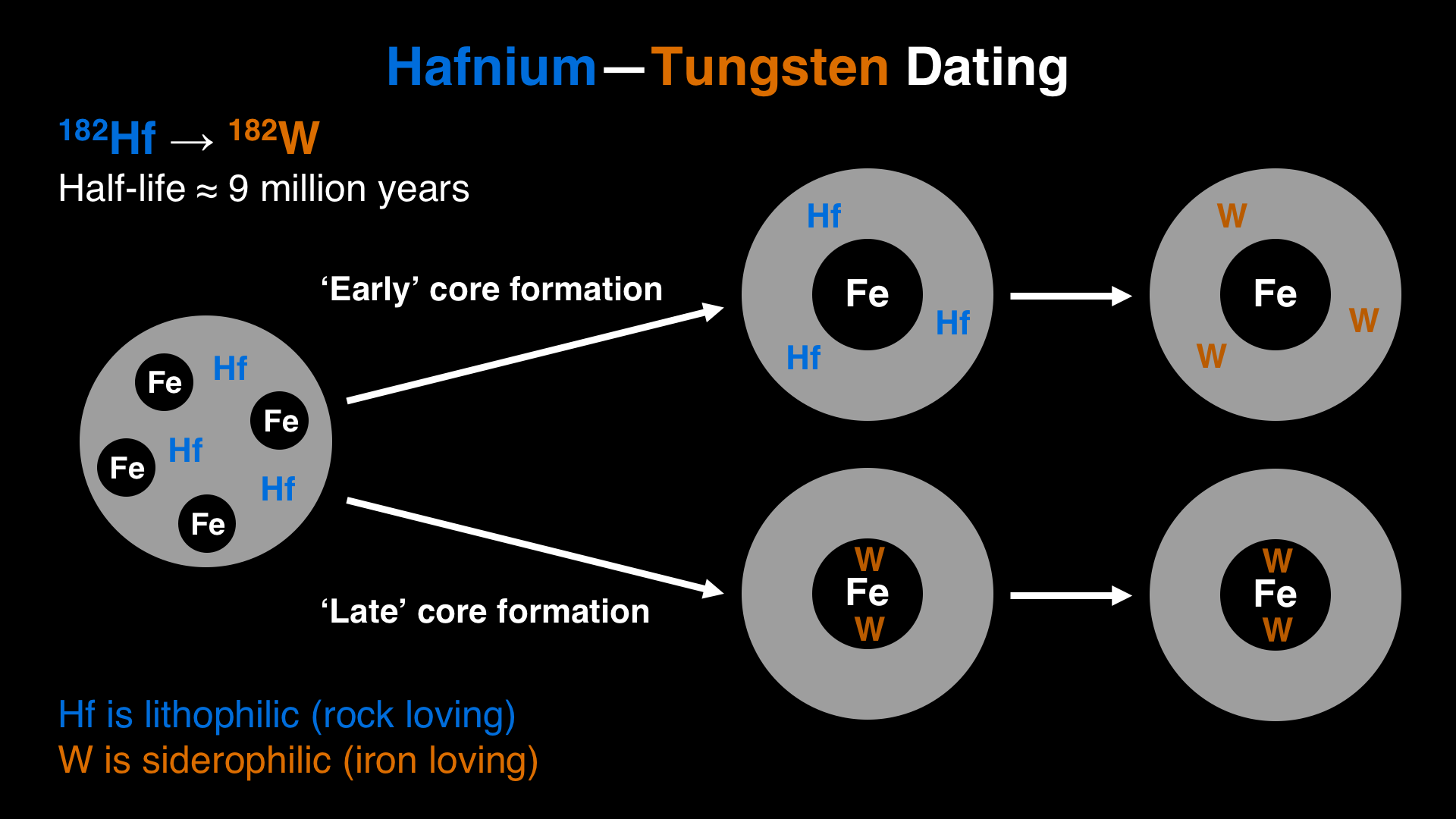
English: Hafnium-182 radioactively decays to tungsten-182 with a half-life of about 9 million years. This system can be used to date when core formation occurred for a particular planet. Hafnium is lithophilic (rock loving) and tungsten is siderophilic (iron loving). Early in a planet's history it would have been undifferentiated, meaning that it would not have been layered according to density (with the densest material being towards the interior of the planet). If differentiation (core formation) occurred relatively early in a planet's history then hafnium would not have much time to decay to tungsten. Being that hafnium is lithophilic, it would remain in the mantle (or outer layers of the planet). Then after some time, hafnium would decay to tungsten. On the other hand, if differentiation (core formation) occurred later in a planet's history, then hafnium would have decayed to tungsten. Being siderophilic, tungsten would move towards the interior of the planet along with iron. In this scenario, not much tungsten would subsequently be present in the outer layers of the planet. As such, by looking at how much tungsten is present in the outer layers of a planet, the time of differentiation (core formation) can be quantified. |
| Дата | |
| Источник | Собственная работа |
| Автор | Viranga13 |
Лицензирование
Я, владелец авторских прав на это произведение, добровольно публикую его на условиях следующей лицензии:


Этот файл доступен по лицензии Creative Commons «С указанием авторства — С сохранением условий» версии 4.0 Международная
- Вы можете свободно:
- делиться произведением – копировать, распространять и передавать данное произведение
- создавать производные – переделывать данное произведение
- При соблюдении следующих условий:
- атрибуция – Вы должны указать авторство, предоставить ссылку на лицензию и указать, внёс ли автор какие-либо изменения. Это можно сделать любым разумным способом, но не создавая впечатление, что лицензиат поддерживает вас или использование вами данного произведения.
- распространение на тех же условиях – Если вы изменяете, преобразуете или создаёте иное произведение на основе данного, то обязаны использовать лицензию исходного произведения или лицензию, совместимую с исходной.
История файла
Нажмите на дату/время, чтобы увидеть версию файла от того времени.
| Дата/время | Миниатюра | Размеры | Участник | Примечание | |
|---|---|---|---|---|---|
| текущий | 15:45, 24 сентября 2019 | | 1920 × 1080 (159 КБ) | wikimediacommons>Viranga13 | User created page with UploadWizard |
Использование файла
Следующая страница использует этот файл:
