Файл:Iapetus by Voyager 2 - enhanced.jpg
Перейти к навигации
Перейти к поиску
Нет версии с бо́льшим разрешением.
Iapetus_by_Voyager_2_-_enhanced.jpg (350 × 350 пкс, размер файла: 19 КБ, MIME-тип: image/jpeg)
| Описание |
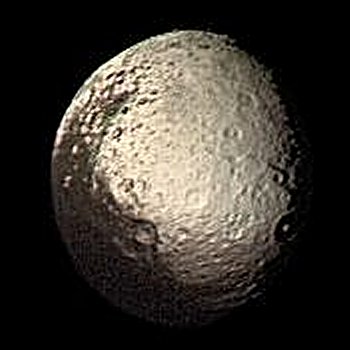
English: Iapetus by Voyager 2 spacecraft, August 22, 1981
Saturn's outermost large moon, Iapetus, has a bright, heavily cratered icy terrain and a dark terrain, as shown in this Voyager 2 image taken on August 22, 1981. Amazingly, the dark material covers precisely the side of Iapetus that leads in the direction of orbital motion around Saturn (except for the poles), whereas the bright material occurs on the trailing hemisphere and at the poles. The bright terrain is made of dirty ice, and the dark terrain is surfaced by carbonaceous molecules, according to measurements made with Earth-based telescopes. Iapetus' dark hemisphere has been likened to tar or asphalt and is so dark that no details within this terrain were visible to Voyager 2. The bright icy hemisphere, likened to dirty snow, shows many large impact craters. The closest approach by Voyager 2 to Iapetus was a relatively distant 600,000 miles, so that our best images, such as this, have a resolution of about 12 miles. The dark material is made of organic substances, probably including poisonous cyano compounds such as frozen hydrogen cyanide polymers. Though we know a little about the dark terrain's chemical nature, we do not understand its origin. Two theories have been developed, but neither is fully satisfactory--(1) the dark material may be organic dust knocked off the small neighboring satellite Phoebe and "painted" onto the leading side of Iapetus as the dust spirals toward Saturn and Iapetus hurtles through the tenuous dust cloud, or (2) the dark material may be made of icy-cold carbonaceous "cryovolcanic" lavas that were erupted from Iapetus' interior and then blackened by solar radiation, charged particles, and cosmic rays. A determination of the actual cause, as well as discovery of any other geologic features smaller than 12 miles across, awaits the Cassini Saturn orbiter to arrive in 2004 |
||
| Дата | Снято: 22 августа 1981 | ||
| Источник | http://photojournal.jpl.nasa.gov/catalog/PIA00348 | ||
| Автор | NASA/JPL/USGS | ||
| Другие версии |
|


Лицензирование

|
Этот файл находится в общественном достоянии (англ. public domain), так как он был создан NASA (Национальным управлением по аэронавтике и исследованию космического пространства). Политика авторского права NASA гласит, что «Материал NASA не защищается авторским правом, если не указано иное». (См. Template:PD-USGov, страницу политики авторского права NASA или политику использования изображений JPL.) |  |
 |
Предупреждения:
|
История файла
Нажмите на дату/время, чтобы увидеть версию файла от того времени.
| Дата/время | Миниатюра | Размеры | Участник | Примечание | |
|---|---|---|---|---|---|
| текущий | 18:29, 4 апреля 2005 | | 350 × 350 (19 КБ) | wikimediacommons>Smartech~commonswiki | *'''Iapetus by Voyager 2 spacecraft, August 22, 1981''' *same as Iapetus_by_Voyager_2.jpg but focused on the mooon and feature-enhanced. *original image caption: Saturn's outermost large moon, Iapetus, has a bright, heavily cratered icy terrain and a da |
Использование файла
Следующие 2 страницы используют этот файл:
